
Rovaniemi in Winter 2026/27: Northern Lights, Direct Flights and a Car-Free Lapland Route
Rovaniemi is one of the easiest places in Finnish Lapland to organise without hiring a car, and the winter 2026/27 season makes that particularly practical. The city has a compact centre, an airport with a large seasonal European network, direct trains to southern Finland, long-distance buses to other Lapland resorts and local buses for several of the places most visitors actually want to reach. At the same time, the Northern Lights season overlaps almost completely with the snowy winter travel period. A sensible trip therefore does not need to be built around long drives on icy roads. It can be arranged as a sequence of walkable city days, public-transport transfers and a few carefully chosen evening activities, with Rovaniemi as the main gateway and Levi or another northern resort as an onward stop.
Getting to Rovaniemi in Winter 2026/27 Without Hiring a Car
Rovaniemi Airport has a much broader winter timetable than its size might suggest. As of October 2026, Visit Rovaniemi lists direct connections from more than 20 European cities for winter 2026/27, with 47 route combinations when individual airlines and airports are counted separately. The network includes London, Manchester, Bristol, Edinburgh, Birmingham, Liverpool and Belfast in the UK; Paris and Lyon in France; Amsterdam, Vienna, Zurich, Brussels, Copenhagen, Prague and Warsaw; several German cities; Madrid and Barcelona; Milan; Dublin and Shannon; Istanbul and Izmir; plus Tromsø and Helsinki. Many of these services are seasonal rather than year-round, so the useful question is not simply whether a route exists, but whether it operates on the exact weekday of your trip.
Travellers who do not have a suitable direct flight still have a straightforward route through Helsinki. Finnair operates several flights each day between Helsinki and Rovaniemi throughout the year, while Norwegian also serves the domestic route regularly. Rail is the slower but more relaxed alternative: daytime services and overnight trains connect southern Finland with Rovaniemi, allowing a traveller to arrive in the city rather than at an airport. For a longer European trip, an overnight train can also replace one hotel night and avoids the need to collect a hire car after landing. VR has published night-train sales into spring 2027, which makes rail a realistic part of a winter itinerary rather than a last-minute backup.
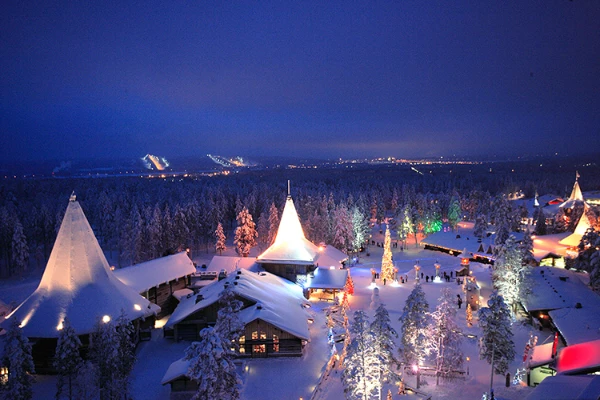
The strongest reason to stay car-free is what happens after arrival. Central Rovaniemi is small enough for ordinary sightseeing on foot, and the railway station, bus station, hotels, restaurants and museums are concentrated within a manageable urban area. Santa Claus Village is about eight kilometres north of the centre, but it does not require a taxi or rental car: local bus 8 runs between Rovaniemi railway station, the city centre and Santa Claus Village, with the 2026/27 timetable valid from 12 August 2026 to 6 June 2027. During the winter season, airport services also connect Rovaniemi Airport with the city and the Santa Claus Village area, so a visitor can move from aircraft to accommodation and major sights using scheduled transport.
Direct Flight Options and the Final Transfer into Town
The winter timetable is especially strong from Britain and France. EasyJet has seasonal Rovaniemi services from London Gatwick, London Luton, London Southend, Manchester, Bristol, Edinburgh, Birmingham and Belfast, while Ryanair operates routes that include London Stansted, Manchester, Birmingham, Bristol and Liverpool. EasyJet’s London Gatwick service is scheduled from 11 November 2026 to 24 March 2027, while Ryanair’s London Stansted route is listed daily from 25 October 2026 to 27 March 2027. British Airways is also adding a Gatwick connection for winter 2026/27, beginning on 4 December 2026. From France, the published schedule includes Paris Charles de Gaulle with Air France and EasyJet, a shorter Finnair seasonal period from Charles de Gaulle, Paris Orly with Transavia and Paris Beauvais with Ryanair, as well as EasyJet from Lyon.
Continental Europe is also well represented. KLM is scheduled between Amsterdam and Rovaniemi from 21 November 2026 to 28 March 2027; Austrian Airlines serves Vienna; Edelweiss serves Zurich; LOT flies from Warsaw; Iberia serves Madrid; Vueling and Norwegian serve Barcelona; and Turkish Airlines operates from Istanbul. Eurowings has winter routes from Düsseldorf, Berlin, Hamburg and Prague, with the Prague service scheduled from 20 December 2026 to 21 February 2027. Lufthansa and Norwegian both have Munich services during the season. Operating days differ sharply by route and may also change around Christmas, New Year and February holiday periods, so it is usually more efficient to choose suitable flights first and then arrange accommodation around those dates.
On arrival, there is little benefit in collecting a car merely for Rovaniemi itself. The Airport Express and other winter airport services cover the airport-city connection, while local bus 8 is the key public route for Santa Claus Village. The village itself is open throughout the year and has no general entrance fee, although individual attractions, restaurants and activities may charge separately. For the rest of Rovaniemi, walking is usually sufficient for the central area, and taxis remain useful for late arrivals or accommodation outside regular bus corridors. Seasonal flight and bus timetables can change, so operating times should be checked again shortly before travel, particularly when a journey depends on the final bus of the day.
Northern Lights in Rovaniemi: What to Expect in the 2026/27 Season
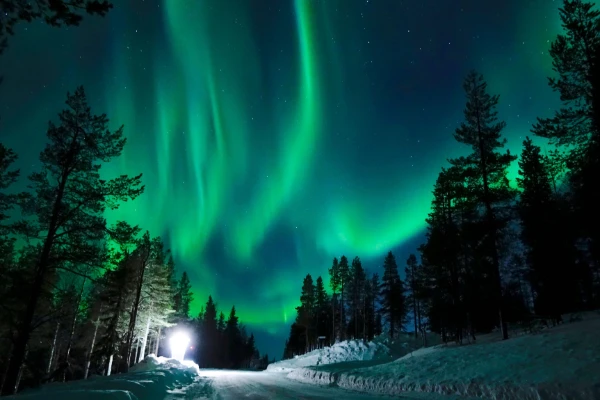
The Northern Lights are possible in Rovaniemi from late August until early April, which means the full winter 2026/27 period falls within the normal viewing season. Snow is not what creates the Aurora, and a snowy landscape does not make an appearance more certain. What matters to the traveller is much simpler: the sky needs to be dark enough, cloud cover needs to leave a clear view and artificial light should be limited where possible. Solar activity controls whether an auroral display reaches Rovaniemi on a given night, so no hotel, guide or forecast can promise a visible display at a specific hour. A realistic itinerary treats the Aurora as a repeated evening opportunity rather than a single event on which the whole holiday depends.
Month choice changes the character of the trip considerably. December has very short days in Rovaniemi, with roughly two and a half hours of daylight on average, while January has around four hours, February around eight and March around twelve. December and early January therefore suit travellers who want the darkest part of the Arctic winter and are comfortable doing much of the day under twilight or darkness. February provides noticeably more usable daylight while retaining long nights, and March is easier for daytime skiing, walking and transfers because the days are much longer. Northern Lights can still appear in all of these months when the weather and solar conditions cooperate, so there is no single winter week that guarantees better results.
For a trip built partly around the Aurora, three or four nights in Rovaniemi are far more sensible than relying on one evening. Cloud can block the sky even during strong solar activity, while a relatively modest forecast can still produce a visible display when local conditions are clear. Check the cloud forecast before focusing too heavily on an Aurora index, then decide whether to walk to a public viewing area or use a guided excursion that can travel farther from local cloud and city lights. This approach also keeps the holiday worthwhile if the lights do not appear: Rovaniemi still offers museums, winter walking, Santa Claus Village, sauna options and organised snow activities during the day.
Where to Watch the Aurora Without Driving
The easiest independent viewing place is the Arctic Garden beside the Arktikum museum. It is close enough to reach on foot from central Rovaniemi and sits by the river, where the northern horizon is more open and there is less direct street lighting than on the main city streets. The park is unlit, so a small torch and proper winter footwear are useful. Ounasvaara is another public option within a few kilometres of the centre. Its higher ground and darker surroundings can improve the view, but winter paths may be icy and covered with snow, making it better suited to visitors who are comfortable walking in cold conditions and have suitable boots.
A guided Aurora trip can be useful even for travellers who normally prefer independent sightseeing because transport is usually part of the service. Many Rovaniemi operators collect guests from central meeting points, Ounasvaara accommodation or the Santa Claus Village area and drive to darker locations outside town. This becomes particularly useful on evenings when a clear patch of sky lies away from Rovaniemi itself. The practical benefit is mobility and local knowledge of changing weather, not a guaranteed Aurora. When comparing tours, check the actual duration, the pick-up area, whether thermal clothing is included and whether the operator is prepared to change the viewing location according to cloud conditions.
Independent viewing should remain on public land. Visit Rovaniemi specifically advises Aurora watchers not to enter private roads, residential yards or holiday-cabin areas simply because a map appears to show a dark location. The Arctic Garden and Ounasvaara are recommended public choices, while more remote recreation areas are better reached through organised transport if you do not have a car. Dress for standing still rather than for a brisk daytime walk: waiting beside a river or on a hill feels considerably colder than moving through the centre. Keep the evening flexible, avoid fixing the whole trip around one forecast, and remember that clear skies and patience are more useful than constantly moving between random locations.
A Practical Car-Free Route Through Lapland for Six to Eight Days
A simple winter route is Rovaniemi first, Levi second and Helsinki last, using a flight, scheduled coach and night train rather than a rental car. Spend the first three nights in central Rovaniemi. This gives enough time for Santa Claus Village, Arktikum or another indoor cultural stop, a walk around the centre and at least two or three chances to look for the Northern Lights. Staying centrally keeps daily logistics easy: bus 8 reaches Santa Claus Village, the railway and bus stations are accessible without a long transfer, and many tour companies use central pick-up points. It also prevents the common mistake of booking remote accommodation and then finding that every meal, museum visit and evening activity requires a taxi.
After Rovaniemi, continue to Levi by long-distance bus. Matkahuolto sells the Rovaniemi-Levi route and gives a typical journey time of about two and a half hours. Levi is a practical second stop because the village has a concentrated centre and its own ski-bus system linking accommodation areas, lifts and the main services during the winter season. A car is therefore not essential for a short stay focused on skiing, winter walking, restaurants and organised activities. Two or three nights in Levi also create additional Aurora evenings in a darker resort environment before the journey turns south. Travelling by coach has another advantage in midwinter: there is no need to deal personally with snow-covered roads, winter tyres, parking or an unfamiliar vehicle in sub-zero conditions.
This route works best when accommodation is chosen for transport rather than for isolation. In Rovaniemi, stay within walking distance of the centre or a known bus corridor; in Levi, choose the village centre or a property served by the ski bus. Organised husky, reindeer, snowmobile and Aurora activities commonly include a meeting point or transfer, so there is little reason to drive solely for excursions. Leave generous time between independently booked bus and rail tickets, especially during heavy snowfall, and do not assume that a late-evening connection will wait for a delayed service. In Lapland, a car-free trip is comfortable when each overnight base has useful local transport; it becomes awkward when accommodation is several kilometres beyond the last regular stop.
Levi to Kolari and the Overnight Train South
For winter 2026/27, the useful final link is the connecting bus between Levi and Kolari railway station. Tunturilinjat publishes services for the season, with the Levi-Kolari train-bus connection running between 14 December 2026 and 18 April 2027 on specified operating days and with additional departures around some peak dates. The bus serves stops in Levi before continuing through the Ylläsjärvi area to Kolari, where selected departures are arranged around onward night trains. This creates a particularly convenient one-way itinerary: fly into Rovaniemi, travel overland to Levi, then leave Lapland by sleeper train from Kolari instead of returning over the same road to Rovaniemi.
VR’s night trains are the practical finish because they connect Lapland with Helsinki while passengers sleep, and winter 2026/27 journeys are on sale into April 2027. Private sleeper cabins are available, including cabins with their own shower, but Christmas, New Year and popular February dates can sell well in advance. The Levi-Kolari connecting bus does not follow exactly the same pattern every day, so the safest planning order is to check the Kolari train and matching bus first, then reserve the final night in Levi. If the dates do not match the Kolari connection, the simpler alternative is to take a bus from Levi back to Rovaniemi and board a southbound train there.
Travellers who prefer a more northerly second base can use Saariselkä instead of Levi. Matkahuolto sells Rovaniemi-Saariselkä bus journeys, including searches beginning at Rovaniemi Airport, and Saariselkä has winter local transport as well as airport-bus connections to Ivalo. That version works well for an open-jaw trip with arrival in Rovaniemi and departure from Ivalo, provided the flight and bus times match. In either version, the principle is the same: choose bases connected by scheduled transport, book the longest intercity legs before committing to non-refundable accommodation and recheck winter timetables shortly before departure. With that order of planning, Rovaniemi and a second Lapland resort can be combined comfortably without driving on Arctic roads.